

Published
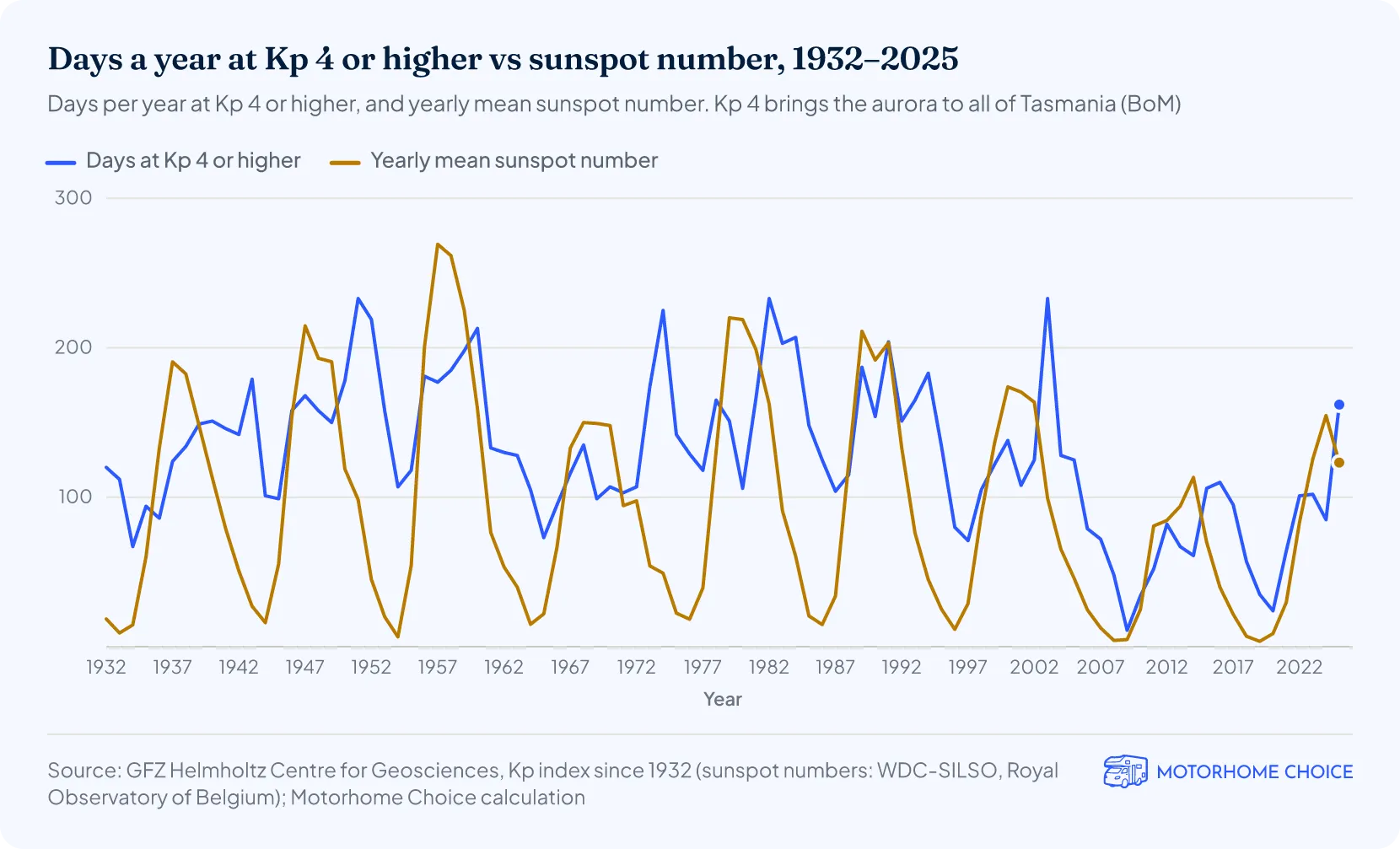
Once geomagnetic activity reaches Kp 4, the aurora australis can be seen from anywhere in Tasmania, says the Bureau of Meteorology1. That happened on about 128 days a year from 1932 to 2025, or roughly one day in three, by our count of the GFZ Kp index2. In 2025 there were 162 such days, the most since 2003.
You also need a dark night and a clear southern sky, so you will see the aurora on fewer nights than these counts suggest.
Key facts
- Kp 3 can bring the aurora to southern Tasmania and Kp 4 to all of Tasmania1.
- About 128 days a year (roughly one in three) reached Kp 4 or higher on average, 1932–20252 (our calculation).
- 59 days a year reached Kp 5 or higher and about 8 days reached Kp 7 or higher, 1932–20252.
- 162 days reached Kp 4 or higher in 2025, the most since 2003's 2332.
- About 3 times as many strong-storm days (Kp 6 or higher) fall in March, April, September and October as in December: roughly 240 each against 77, 1932–20252.
- 4 storms at the Kp 9 level, the top of the scale, since 2006: 10–11 May 2024, 10 October 2024, 12 November 2025 and 19 January 20262.
- Fewer than 2 days a year reached Kp 7 or higher in the 2010s, the quietest decade on record, against about 14 in the 1950s2.
- 2024: NASA and NOAA announced in October that the Sun had reached the maximum period of its roughly 11-year cycle3.
How often can you see the aurora australis in Tasmania?
On average, 127.7 days a year reached Kp 4 or higher between 1932 and 20252, enough to bring the aurora over all of Tasmania. That is about one day in three. Not all of them are useful: on many, the activity peaks in daylight or under cloud.
Activity follows the Sun's roughly 11-year sunspot cycle. The busiest years, 1951, 1982 and 2003, each had 233 days at Kp 4 or higher; the quietest, 2009, had 112. In 2025 there were 162, the most since 2003, even though sunspots peaked in 2024. That is normal: geomagnetic storms often keep coming for a year or more after the sunspot peak.
What Kp level do you need to see the aurora in Tasmania?
Kp 3 is enough for the aurora australis to reach southern Tasmania, and Kp 4 brings it to the whole state, according to the Bureau of Meteorology's Space Weather Services1. Higher levels push it further north: to the coastline of Victoria at Kp 5, southern NSW at Kp 7 and southern Queensland at Kp 8.
Kp runs from 0 to 9. GFZ Helmholtz Centre for Geosciences in Germany calculates it every three hours from 13 geomagnetic observatories around the world4.
| Kp | Geomagnetic activity | Aurora can be seen as far north as |
|---|---|---|
| 3 | Unsettled | Southern Tasmania |
| 4 | Active | All of Tasmania |
| 5 | Minor storm | Coastline of Victoria |
| 6 | Major storm | Southwest coast of Western Australia |
| 7 | Severe storm | Southern NSW |
| 8 | Severe storm | Southern Queensland |
| 9 | Severe storm | The tropics |
Source · Bureau of Meteorology, Space Weather Services, northern limit of aurora visibility (accessed 14 October 2026).
When is the best time of year to see the aurora australis in Tasmania?
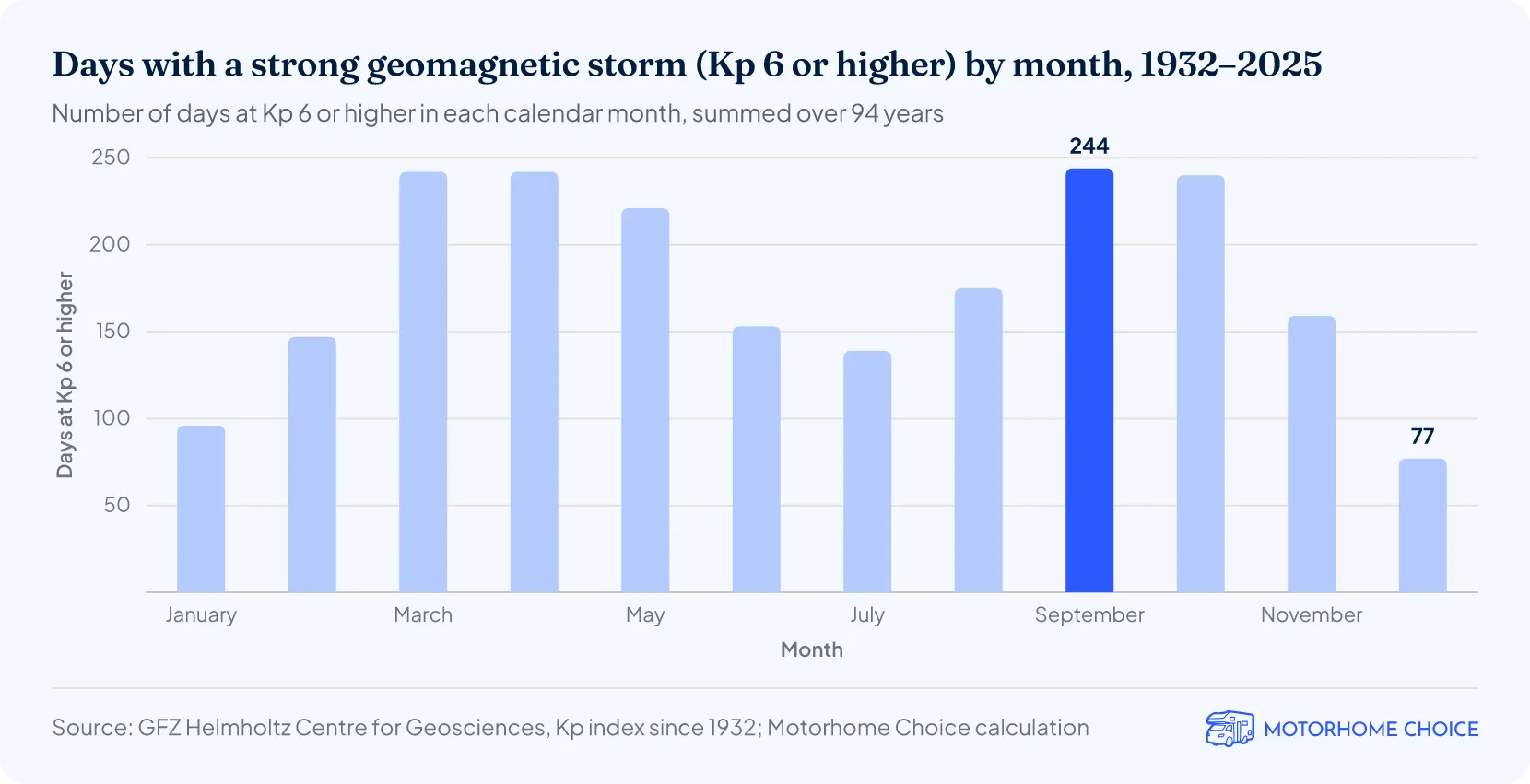
March, April, September and October are the best months. Strong geomagnetic storms (Kp 6 or higher) are about three times likelier then than in December2: from 1932 to 2025 there were 242 such days in March, 242 in April, 244 in September and 240 in October, against 77 in December.
Winter has a different advantage. June and July have the longest nights, and so the most dark hours to watch, even though storms are less frequent. Midsummer is the hardest time: the nights are short and dusk comes late.
What were the biggest geomagnetic storms seen from Tasmania?
Kp has reached the top of the scale, 9− or 9, on 87 days since 1932 and on 17 days since 20002. Then came a long gap: none between 24 August 2005 and May 2024. Since then there have been four such storms: 10–11 May 2024, 10 October 2024, 12 November 2025 and 19 January 2026.
After October 2003, only one day reached Kp 9 itself, the absolute maximum: 11 May 20242. At that level, the Bureau of Meteorology says, the aurora can reach as far north as the tropics1.
| Date (UT) | Highest three-hour Kp |
|---|---|
| 7 April 2000 | 9− |
| 15 July 2000 | 9 |
| 31 March 2001 | 9− |
| 6 November 2001 | 9− |
| 29 October 2003 | 9 |
| 30 October 2003 | 9 |
| 20 November 2003 | 9− |
| 27 July 2004 | 9− |
| 8 November 2004 | 9− |
| 9 November 2004 | 9− |
| 10 November 2004 | 9− |
| 24 August 2005 | 9− |
| 10 May 2024 | 9− |
| 11 May 2024 | 9 |
| 10 October 2024 | 9− |
| 12 November 2025 | 9− |
| 19 January 2026 | 9− |
Source · GFZ Helmholtz Centre for Geosciences, Kp index since 1932 (downloaded 14 October 2026); Motorhome Choice calculation. Kp 9− is 8.67 on GFZ's scale; dates are Universal Time.
Has aurora activity changed since the 1950s?
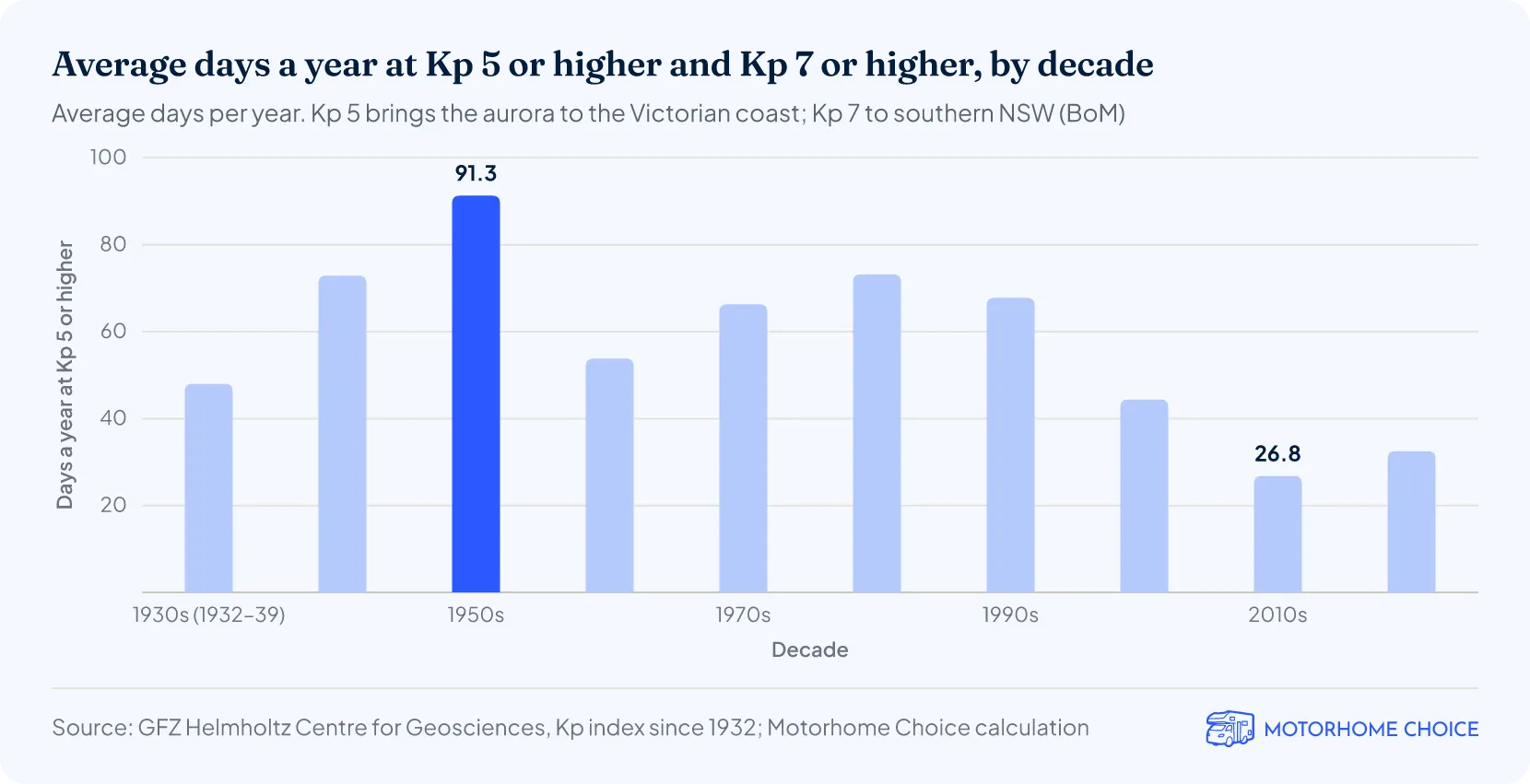
Yes. The 2010s were the quietest decade since records began in 1932, with Kp 7 or higher on 1.8 days a year, against 14.2 in the 1950s2. Days at Kp 5 or higher fell from 91.3 a year in the 1950s to 26.8 in the 2010s.
The 2020s have been livelier so far, with Kp 7 or higher on 4.7 days a year from 2020 to 20252. That is still well below every decade from the 1940s to the 2000s.
Will there be more auroras in Tasmania in 2026 and 2027?
Probably fewer. NASA and NOAA announced in October 2024 that the Sun had reached the maximum phase of its 11-year cycle, and said that phase could last another year3. The count is already falling: Kp 4 or higher was reached on 86 days in 2026 to 13 October, against 127 by the same date in 20252.
Strong storms can still come on the way down. In the last cycle, yearly sunspot numbers were highest in 2000 and 2001, but 2003 was the busiest year for geomagnetic activity2. The most recent strong storm was on 10 October 2026, when the preliminary Kp reached 7+.
How can you improve your chances of seeing the aurora in Tasmania?
Watch two things: the Kp and the cloud. The Bureau of Meteorology's Space Weather Services publishes live geomagnetic conditions and aurora alerts, watches and outlooks1. At Kp 4 or more, all of Tasmania is in range.
Then get away from town lights and find a clear view to the south, ideally on a moonless night. Cloud is what usually stops you. Touring Tasmania by campervan or motorhome lets you drive to whichever stretch of coast has the clearest southern sky that night. And take a camera: the aurora often shows more strongly on the sensor than to the naked eye.
More Tasmania facts & statistics
Motorhome and campervan hire in Tasmania
References
- Aurora – Latest conditions: Geomagnetic indices and northern limit of aurora visibilitysws.bom.gov.auRetrieved 2026-10-14
- Geomagnetic Kp index, ap, Ap and sunspot number since 1932 (daily file)kp.gfz-potsdam.deRetrieved 2026-10-14
- NASA, NOAA: Sun reaches maximum phase in 11-year solar cyclescience.nasa.govPublished 2024-10-15 · Retrieved 2026-10-14