

Published
The last known Tasmanian tiger, or thylacine, died at Beaumaris Zoo in Hobart on 7 September 1936, according to the National Museum of Australia1. The species has been officially extinct since 1986. Sightings are still reported: a 2023 University of Tasmania-led study mapped more than 1,200 sighting records dating from 19102.
Key facts
- 7 September 1936: the last known thylacine died at Beaumaris Zoo, Hobart1.
- 59 days: how long the species had been protected when that animal died (1936)1.
- More than 2,180 government bounties were paid for thylacines between 1888 and 19091.
- 1930: the last known shooting of a wild thylacine1.
- 1986: the year the thylacine was declared extinct3.
- More than 1,200 sighting records from 1910 onwards were analysed in a 2023 University of Tasmania-led study2.
- 8 thylacine sighting reports were made to the Tasmanian Government between September 2016 and September 20194.
- 2,000 years: thylacines have been extinct on mainland Australia for at least this long5.
When did the Tasmanian tiger go extinct?
The last known thylacine died at Beaumaris Zoo in Hobart on 7 September 1936, possibly from exposure and neglect, according to the National Museum of Australia1. The species was declared extinct 50 years later, in 19863.
- The thylacine had been granted protected status just 59 days before that death1.
- The last known shooting of a wild thylacine took place in 1930, and by the mid-1930s sightings in the wild were extremely rare1.
- On the mainland the thylacine died out far earlier, not less than 2,000 years ago, probably because of competition with the dingo and perhaps hunting5.
- September 2026 marked 90 years since the last known thylacine died.
| Thylacine timeline: from mainland extinction to de-extinction research | |
|---|---|
| When | What happened |
| At least 2,000 years ago | Thylacine becomes extinct on mainland Australia5 |
| 1803 | Europeans arrive in Tasmania, where thylacines are widespread3 |
| 1824 | Sheep are introduced, starting conflict between settlers and thylacines3 |
| 1830 | The Van Diemen's Land Company introduces a bounty on thylacines3 |
| 1888 | Government bounty begins: £1 per adult, 10 shillings per juvenile1 |
| 1909 | Government bounty ends, after more than 2,180 bounties were paid1 |
| 1930 | Last known shooting of a wild thylacine1 |
| May 1936 | An old female trapped in the Florentine Valley is sold to Beaumaris Zoo6 |
| 1936 | Thylacine becomes a protected species, 59 days before the last known death1 |
| 7 September 1936 | The last known thylacine dies at Beaumaris Zoo, Hobart1 |
| 1986 | Thylacine declared extinct3 |
| 2016 to 2019 | Eight sighting reports are made to the Tasmanian Government4 |
| 2022 | Remains of the last known thylacine identified at the Tasmanian Museum and Art Gallery6 |
| 2023 | University of Tasmania-led study maps 1,237 sighting records from 19102 |
| October 2024 | Colossal and the University of Melbourne announce a reconstructed thylacine genome7 |
Source · Australian Museum; Parks and Wildlife Service Tasmania; National Museum of Australia; Tasmanian Museum and Art Gallery; DPIPWE Right to Information release (2019); University of Tasmania (2023); University of Melbourne (2024).
How many Tasmanian tigers were killed for bounties?
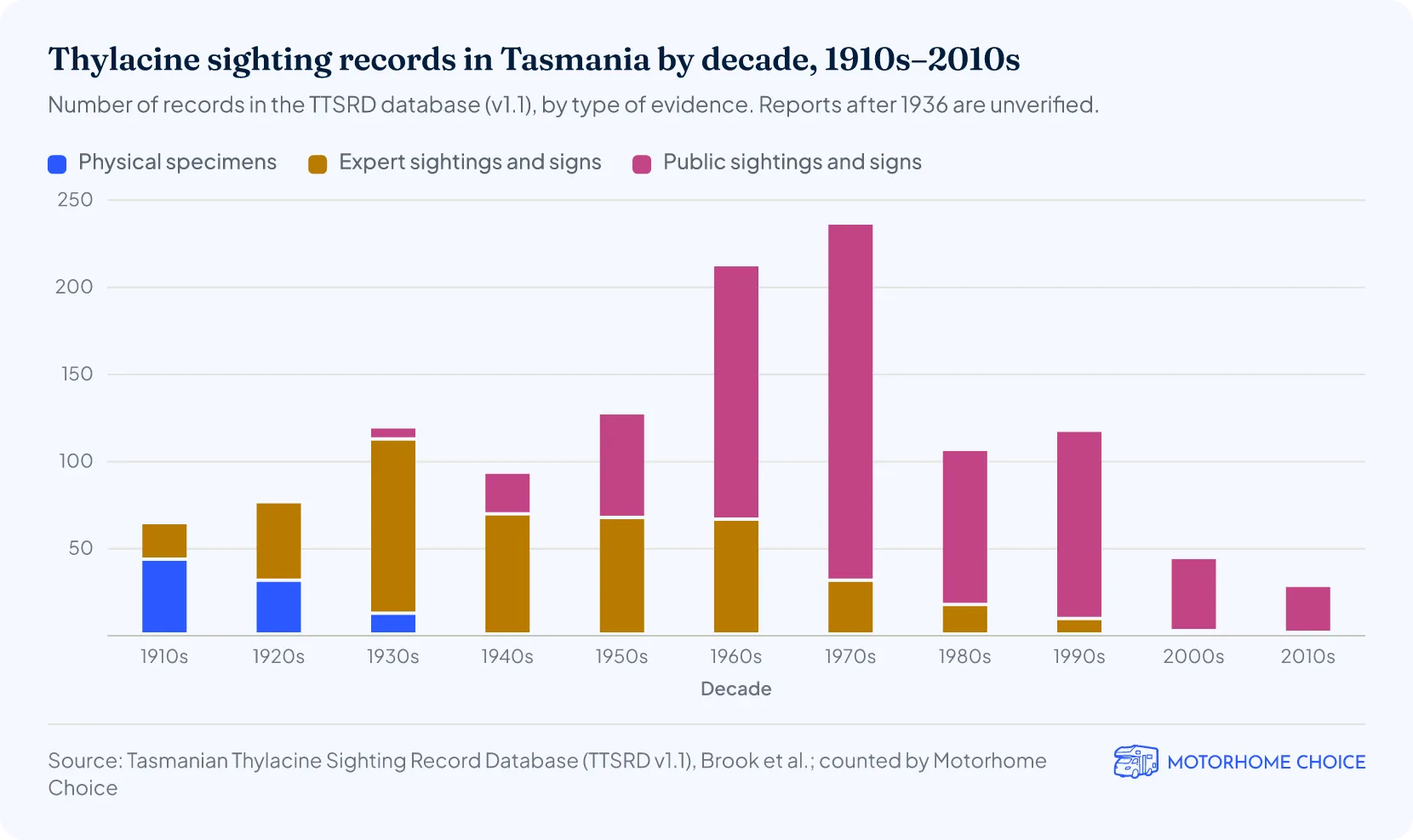
How many Tasmanian tiger sightings have been reported?
A database built for a 2023 University of Tasmania-led study holds 1,237 thylacine records from Tasmania dating from 19102. Its revised version, with duplicates and museum-record errors removed, keeps 1,2238, and 1,011 of them (83%) date from 1937 onwards, after the last known thylacine died in 1936 (our calculation).
How many thylacine sightings were reported to the Tasmanian Government from 2016 to 2019?
Eight thylacine sighting reports were made to Tasmania's Department of Primary Industries, Parks, Water and Environment (DPIPWE) between 1 September 2016 and 19 September 2019, according to documents released under Right to Information in 20194. The reports are unverified.
- Seven reports describe an animal and one describes a footprint, found on the walk up Sleeping Beauty mountain4.
- Five of the eight sightings were made on or beside a road4.
- Four came from the north-west and the western highlands: Corinna, the Murchison Highway near Waratah, King William Saddle and the Mount Roland area4.
- One report, made in August 2019, described a sighting from about seven years earlier4.
| Thylacine sighting reports made to DPIPWE, September 2016 to September 2019 | ||
|---|---|---|
| Report made | Area | What was reported |
| 2 September 2016 | Union Bridge Road, south of Sheffield (Mount Roland area) | An animal on the road before dawn (about 6.15 am) in June or July 2016, seen for 4 to 5 seconds4 |
| 3 January 2017 | Murchison Highway, about 16 km north of Waratah | An animal running across the road in front of a car on 27 December 20164 |
| 24 April 2017 | Outside Launceston | A strongly striped animal crossing the highway at night on 23 April 20174 |
| 18 February 2018 | King William Saddle, Lyell Highway | A striped animal crossing the road, seen by one of a group of riders touring Tasmania4 |
| 25 February 2018 | Corinna | A striped animal on the gravel road, seen for 12 to 15 seconds on 21 January 20184 |
| 26 November 2018 | Hartz Mountains | An adult and two cubs4 |
| 29 July 2019 | Sleeping Beauty mountain (Mountain River side) | A footprint4 |
| 15 August 2019 | Midlands | A sighting on the person's land about seven years earlier4 |
Source · DPIPWE, Thylacine Sighting Reports, 1 September 2016 to 19 September 2019 (Right to Information release RTI 025 2019-20). Unverified reports; personal details were redacted in the release.
Is the Tasmanian tiger extinct?
Yes. The thylacine has been officially extinct since 1986, and there is no conclusive evidence that it survived, according to the National Museum of Australia1. A 2023 study led by University of Tasmania professor Barry Brook found extinction most likely happened within four decades of the last capture, around the 1940s to 1970s2.
- Further analysis in the same study found extinction might have been as recent as the late 1980s to early 2000s2.
- The authors saw a very small chance that the species still persists in Tasmania's remote south-western wilderness2.
- The study found the thylacine's range shrank rapidly after the government bounty period (1888 to 1909)2.
Who was the last Tasmanian tiger?
The last known thylacine was an old female captured by trapper Elias Churchill in the Florentine Valley and sold to Beaumaris Zoo in the middle of May 1936, according to the Tasmanian Museum and Art Gallery (TMAG)6. Researchers Robert Paddle and Kathryn Medlock identified her remains in TMAG's collection in 2022.
- The much-photographed and filmed zoo thylacine was in fact the second-last, TMAG says6.
- Researchers in 2022 confirmed it was a myth that the last thylacine was a male or named Benjamin, the National Museum of Australia notes1.
- In 2022 TMAG put her tanned skin and her skeleton, still attached to five cards made for the museum's education collection, on display in its thylacine gallery6.
- If you are touring Tasmania by motorhome, the museum is a short walk from the Hobart waterfront and entry is free9.
How big was a Tasmanian tiger?
A fully grown thylacine measured about 180 cm from nose to tail tip, stood about 58 cm high at the shoulder and weighed up to 30 kg, according to the Parks and Wildlife Service Tasmania3.
- Its brown fur carried 13 to 20 dark brown-black stripes from the base of the tail to almost the shoulders3.
- Thylacines lived for up to nine years in zoos; life expectancy in the wild was thought to be five to seven years3.
- It had 46 teeth, and females raised litters of up to four young in a backward-opening pouch5.
Can the thylacine be brought back from extinction?
No thylacine has been brought back. In October 2024 the de-extinction company Colossal and its partner since 2022, the University of Melbourne's TIGRR Lab, said they had reconstructed a thylacine genome they estimate to be more than 99.9% accurate7.
More Tasmania facts & statistics
Motorhome and campervan hire in Tasmania
References
- 1936: Tasmania's thylacine becomes extinct – Defining Moments (National Museum of Australia)nma.gov.auPublished 2026-09-07 · Retrieved 2026-10-14
- New study reveals that the Tasmanian tiger might have survived to 1980s or later (University of Tasmania, 27 March 2023)utas.edu.auPublished 2023-03-27 · Retrieved 2026-10-14
- Thylacine Sighting Reports, 1 September 2016 to 19 September 2019 (DPIPWE Right to Information release RTI 025 2019-20)nre.tas.gov.auPublished 2019-10-15 · Retrieved 2026-10-14
- Thylacine mystery solved in TMAG collections (Tasmanian Museum and Art Gallery, December 2022)tmag.tas.gov.auPublished 2022-12-05
- New milestones help drive solutions to extinction crisis (University of Melbourne, 17 October 2024)unimelb.edu.auPublished 2024-10-17 · Retrieved 2026-10-14
- Tasmanian Thylacine Sighting Record Database (TTSRD) v1.1 – Brook, Sleightholme, Campbell, Jarić and Buettel (GitHub)github.comRetrieved 2026-10-14