

Updated
The Spirit of Tasmania carried about 399,000 one-way passengers across Bass Strait in 2024-25, 5% fewer than the year before, according to figures the Bureau of Infrastructure and Transport Research Economics (BITRE) published in July 20261. Two bigger ships, Spirit of Tasmania IV and V, take over the Geelong–Devonport crossing from 31 October 20262.
Key facts
- About 399,000 one-way passengers sailed on the Spirit of Tasmania in 2024-25, down from 450,000 in 2022-231.
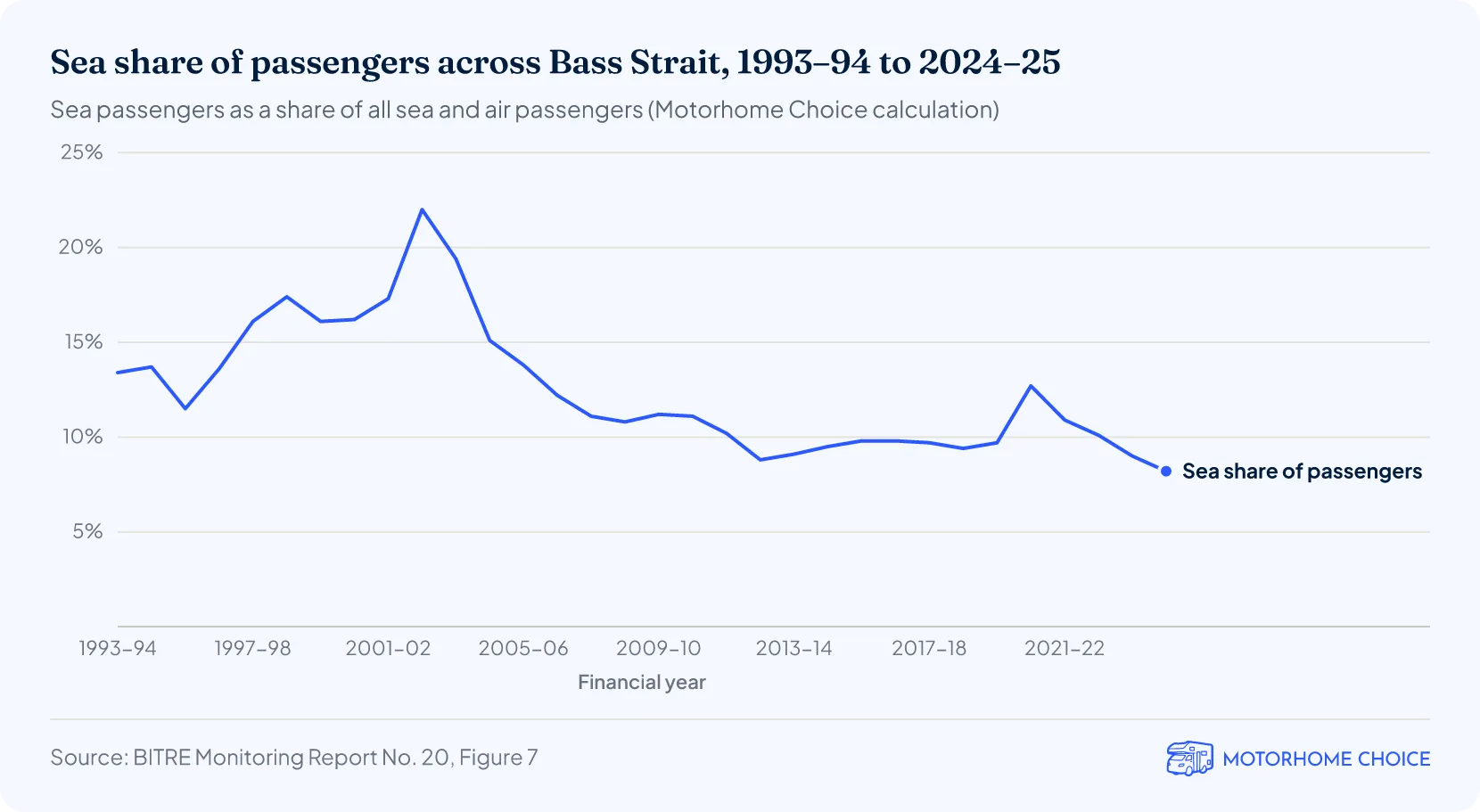
- About 8% of all trips across Bass Strait in 2024-25 were made by sea, the lowest share since at least 1993-943 (our calculation).
- About 181,000 vehicles crossed with the federal Bass Strait rebate in 2024-25, including about 6,400 motor homes, 6,100 campers and 16,700 cars towing caravans1.
- 10% more motor homes crossed in 2024-25 than in 2022-23, while motor cars fell 20%1.
- 1,800 passengers fit on each new ship, up from 1,400, with 60% more vehicle lane space (2026)1.
- 31 October 2026 is the first passenger sailing for Spirit of Tasmania IV and V2.
- 9 to 11 hours is how long the Geelong–Devonport crossing takes (2026)4.
- More than 320,000 passengers crossed Bass Strait on the Spirit over summer 2025-265.
How many passengers travel on the Spirit of Tasmania?
The Spirit of Tasmania carried 398,814 one-way passengers in 2024-251. That was 4.9% fewer than the 419,349 carried in 2023-24 and 11% fewer than the 450,012 in 2022-23, the year the service moved from Melbourne to Geelong.
- That is about 1,090 passengers a day, or 455 a voyage across 876 one-way voyages in 2024-251.
- Each current ship carries up to 1,400 passengers, so the average crossing in 2024-25 was about a third full. Summer is much busier: vehicle numbers each January are around twice the yearly average1.
- Sea passenger numbers peaked at 505,639 in 2003-04, when a third ship also sailed from Sydney3.
- More than 320,000 passengers crossed Bass Strait on the Spirit over the 2025-26 summer, according to the Tasmanian Government5.
| Spirit of Tasmania passengers, vehicles and voyages, 2015-16 to 2024-25 | ||||
|---|---|---|---|---|
| Financial year | One-way passengers | Rebated passenger vehicles | One-way voyages | Passengers per voyage |
| 2015-16 | 419,2101 | 189,662 | 814 | 515 |
| 2016-17 | 434,0841 | 190,226 | 838 | 518 |
| 2017-18 | 447,5391 | 225,058 | 859 | 521 |
| 2018-19 | 451,7071 | 205,479 | 867 | 521 |
| 2019-20 | 351,2241 | 159,156 | 846 | 415 |
| 2020-21 | 234,7251 | 123,404 | 806 | 291 |
| 2021-22 | 284,3231 | 147,919 | 823 | 345 |
| 2022-23 | 450,0121 | 214,655 | 896 | 502 |
| 2023-24 | 419,3491 | 201,253 | 905 | 463 |
| 2024-25 | 398,8141 | 180,637 | 876 | 455 |
Source · BITRE, Bass Strait Passenger Vehicle Equalisation Scheme Monitoring Report No. 20 (July 2026), Tables 5 and 6 (TT-Line data). Passengers include foot (berth-only) passengers; vehicles are those carried by TT-Line that received the Bass Strait rebate.
Do more people fly or sail to Tasmania?
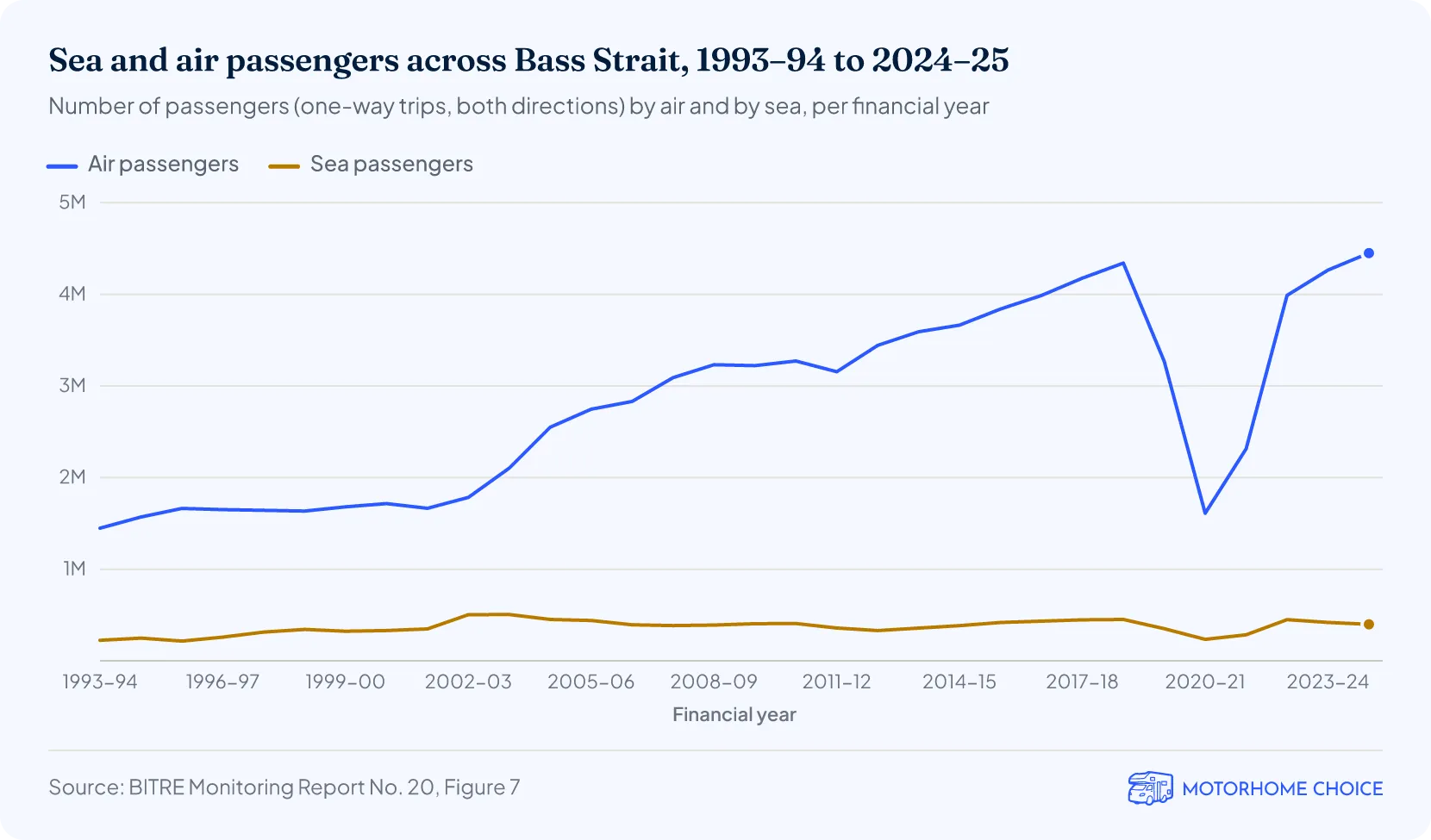
Far more people fly. About 4.45 million air passengers crossed Bass Strait in 2024-25, against 398,814 by sea, so only 8.2% of trips were made on the Spirit of Tasmania3 (our calculation). Air passenger numbers rose 6.9% in 2023-24 and a further 4.4% in 2024-25, while sea passengers fell 6.8% and then 4.9%1.
- The sea share peaked at 22.0% in 2002-03, when Spirit of Tasmania I and II replaced the original ship and sailings more than doubled1.
- The 8.2% share in 2024-25 is the lowest since the sea and air series began in 1993-943.
- Visitors who arrive by sea spend more in Tasmania: $4,089 per visitor against $2,514 for air visitors in the 12 months to June 20251.
- Every sea visitor in the survey visited the North West (the ship docks at Devonport), compared with 35% of air visitors1.
| Regions of Tasmania visited by sea and air visitors, 12 months to June 2025 | ||
|---|---|---|
| Region | Sea visitors | Air visitors |
| Hobart & Surrounds | 78%1 | 79% |
| Northern | 85%1 | 52% |
| Southern | 68%1 | 47% |
| North West | 100%1 | 35% |
| East Coast | 61%1 | 30% |
| West Coast | 40%1 | 13% |
Source · Tourism Tasmania, Tasmanian Visitor Survey, as published in BITRE Monitoring Report No. 20 (July 2026), Table 10.
How many vehicles go on the Spirit of Tasmania?
A total of 180,746 passenger vehicles crossed Bass Strait with the Australian Government's rebate in 2024-25, 15.9% fewer than in 2022-231. TT-Line's Spirit of Tasmania carried 180,637 of them; the rest went to King Island with Bass Island Line.
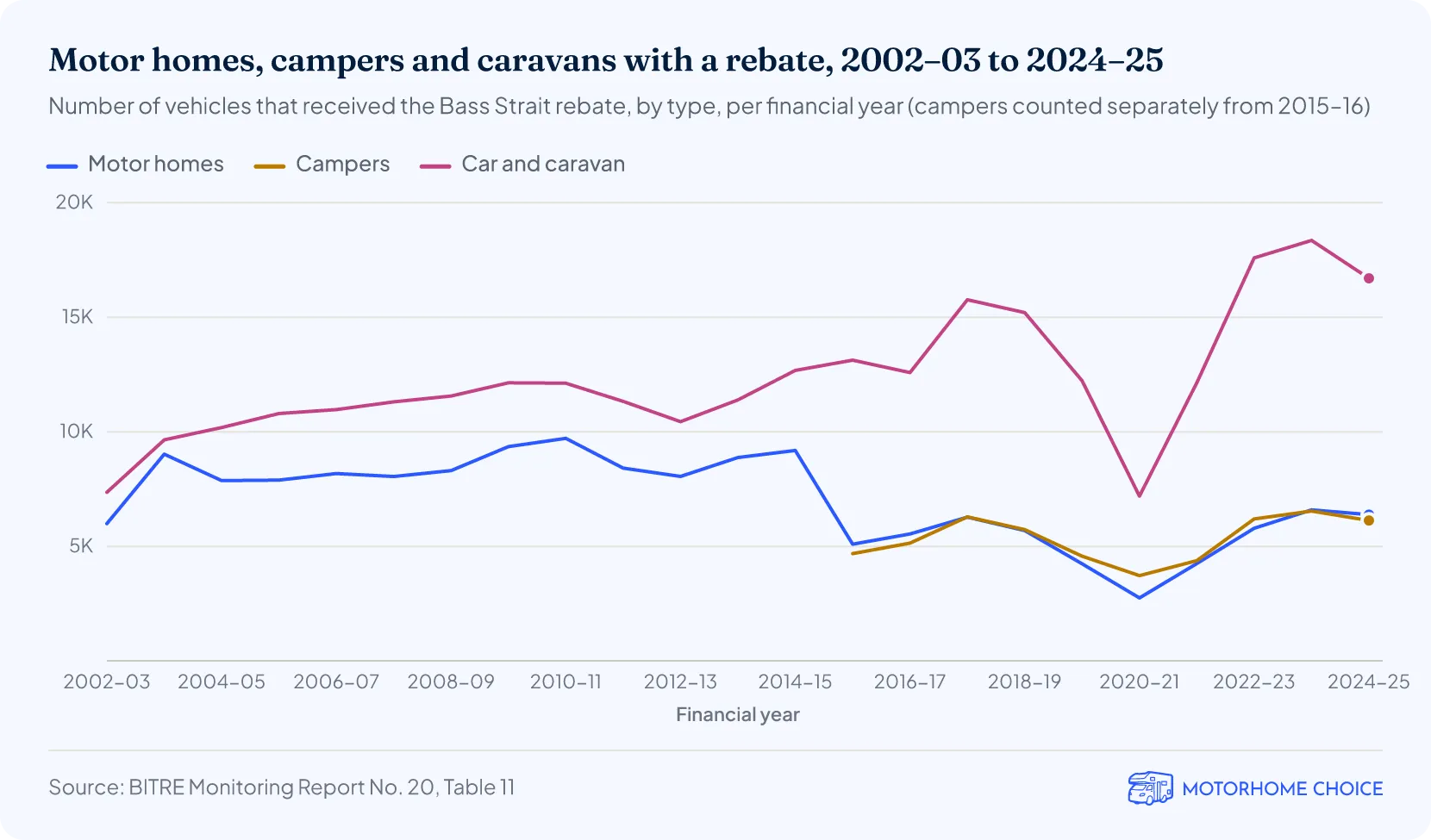
- Motor homes rose 10.3% between 2022-23 and 2024-25, to 6,384, while motor cars fell 19.6% to 139,6531.
- 16,701 cars towing caravans and 6,127 campers also crossed in 2024-251.
- Motor homes, campers and caravan rigs together numbered 29,212 in 2024-25, or 16.2% of all rebated vehicles, more than double the 13,350 in 2002-033.
- Over the same period motor cars fell 29%, from 196,871 to 139,6533.
- In 2024-25 the ships carried an average of 206 rebated vehicles per voyage, against a capacity of 500 vehicles per ship1.
| Vehicles that crossed Bass Strait with the rebate, by type | ||||
|---|---|---|---|---|
| Vehicle type | 2022-23 | 2023-24 | 2024-25 | Change 2022-23 to 2024-25 |
| Motor cars | 173,736 | 158,564 | 139,6531 | -19.6% |
| Car and caravan | 17,592 | 18,354 | 16,7011 | -5.1% |
| Motorcycles | 10,761 | 10,568 | 10,8831 | +1.1% |
| Campers | 6,196 | 6,540 | 6,1271 | -1.1% |
| Motor homes | 5,788 | 6,592 | 6,3841 | +10.3% |
| Bicycles | 635 | 712 | 9271 | +46.0% |
| Buses | 93 | 93 | 711 | -23.7% |
| Total | 214,801 | 201,423 | 180,7461 | -15.9% |
Source · BITRE, Bass Strait Passenger Vehicle Equalisation Scheme Monitoring Report No. 20 (July 2026), Table 11 (Services Australia data, all operators).
How many Spirit of Tasmania ships are there?
Two Spirit of Tasmania ships are in service: Spirit of Tasmania I and Spirit of Tasmania II, which sail between Geelong and Devonport, departing both ports most nights4. Two new ships, Spirit of Tasmania IV and Spirit of Tasmania V, replace them from 31 October 2026, and the current pair will then be sold.
- Each current ship carries up to 1,400 passengers and 500 vehicles1.
- There was a Spirit of Tasmania III: it ran a Sydney–Devonport service from January 2004 until that route closed in August 20061.
- The Victorian port moved from Melbourne to Geelong in October 20221.
- TT-Line made 876 one-way voyages in 2024-25, 29 fewer than in 2023-241.
How big are the new Spirit of Tasmania ships?
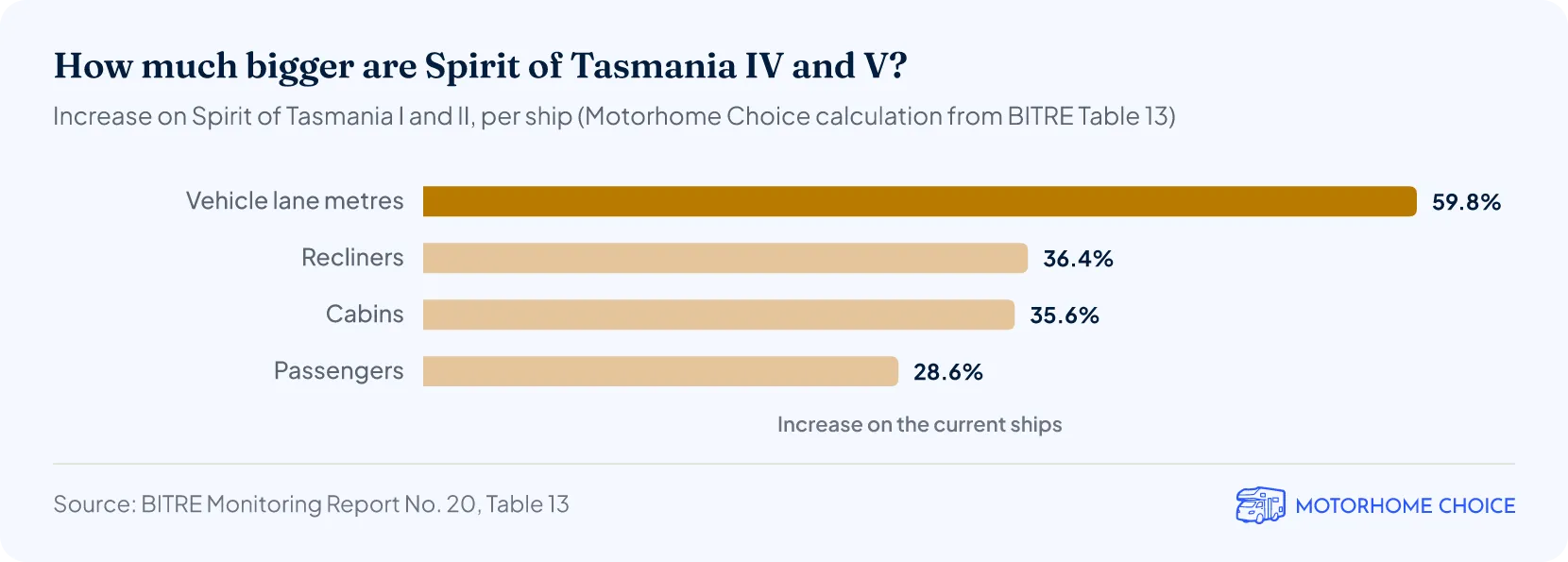
| Spirit of Tasmania I and II compared with Spirit of Tasmania IV and V (per ship) | |||
|---|---|---|---|
| Measure | Spirit of Tasmania I & II | Spirit of Tasmania IV & V | Change |
| Passengers | 1,400 | 1,8001 | +28.6% |
| Cabins | 222 | 3011 | +35.6% |
| Recliners | 121 | 1651 | +36.4% |
| Vehicle lane metres | 2,565 | 4,0981 | +59.8% |
| Length | 194.3 m | 212 m4 | +9.1% |
Source · BITRE Monitoring Report No. 20 (July 2026), Table 13; lengths from Spirit of Tasmania FAQs (checked October 2026).
When do the new Spirit of Tasmania ships start sailing?
How long does the Spirit of Tasmania take?
The Spirit of Tasmania takes 9 to 11 hours to cross Bass Strait between Geelong and Devonport: 11 hours on days with a single sailing and 9 hours on days with double sailings4. Ships leave both ports most nights.
How much does the Spirit of Tasmania cost with a caravan or motorhome?
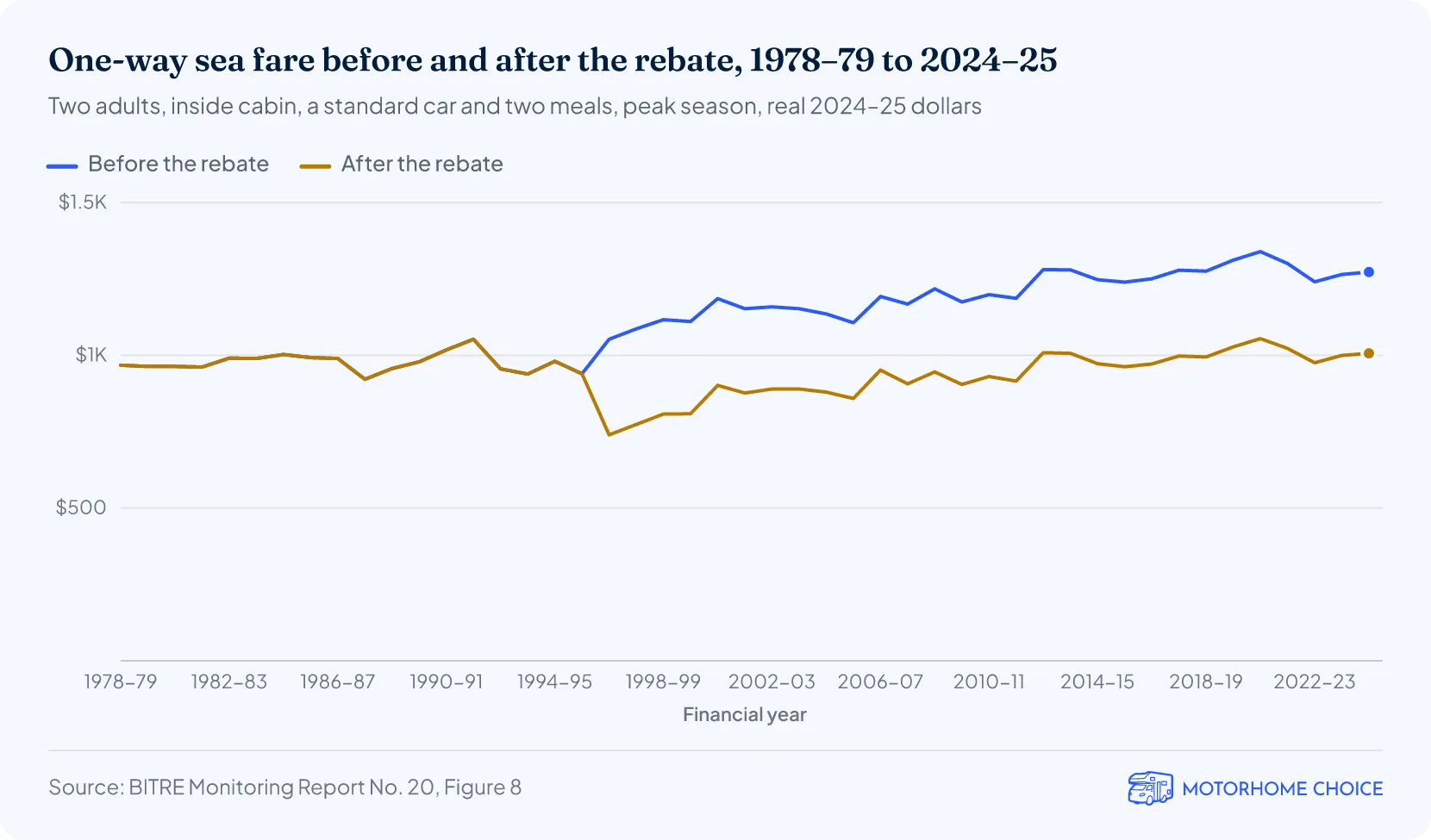
Fares change with the date, the season and the size of your rig. As a benchmark, a peak-season one-way trip for two adults with an inside cabin, a standard car and two meals cost $1,007 in 2024-25 after the rebate, up from $914 in 2022-23 (prices as paid at the time)1. The Australian Government's rebate comes off the vehicle fare: in 2024-25 it was up to $535 each way for a motor home or a car towing a caravan, and up to $266 for a car.
- In real terms, the benchmark after the rebate is 4% dearer than in 1978-79, before the rebate existed: $1,007 against $968 in 2024-25 dollars3 (our calculation).
- For the new ships, the Tasmanian Government advertised passenger and vehicle fares from $49 each and cabin upgrades from $125 (September 2026)2.
- On a short trip, flying in and hiring a motorhome or campervan in Tasmania saves two overnight crossings and the vehicle fares.
| Bass Strait rebate per vehicle, one way | ||
|---|---|---|
| Vehicle | To 30 June 2024 (AUD) | To 30 June 2025 (AUD) |
| Motor car or bus | Up to $259 | Up to $2661 |
| Motor home | Up to $521 | Up to $5351 |
| Vehicle towing a caravan | Up to $521 | Up to $5351 |
| Motorcycle | Up to $133 | Up to $1371 |
| Bicycle | Up to $40 | Up to $411 |
Source · BITRE Monitoring Report No. 20 (July 2026), Table 2. A return trip gets exactly double the one-way rebate.
Does the Spirit of Tasmania make a profit?
No. TT-Line, the Tasmanian Government company that runs the Spirit of Tasmania, reported an after-tax loss of $16.5 million in 2024-25, after a loss of about $13 million in 2023-24 and an $8.6 million profit in 2022-231. The Australian Government paid $53.9 million under the vehicle rebate scheme in 2024-25, down from $58.3 million in 2023-24.
More Tasmania facts & statistics
Motorhome and campervan hire in Tasmania
References
- Bass Strait Passenger Vehicle Equalisation Scheme Monitoring Report No. 20 (July 2026)bitre.gov.auPublished 2026-07-02 · Retrieved 2026-10-14
- Bookings set to open for new Spirit of Tasmania features (Tasmanian Government media release, 15 September 2026)premier.tas.gov.auPublished 2026-09-15 · Retrieved 2026-10-14
- Bass Strait Passenger Vehicle Equalisation Scheme Monitoring Report No. 20 — figures workbook (July 2026)bitre.gov.auPublished 2026-07-02 · Retrieved 2026-10-14
- Frequently Asked Questions (Spirit of Tasmania / TT-Line)spiritoftasmania.com.auRetrieved 2026-10-14
- Big summer of sailing as industry gears up for new Spirits (Tasmanian Government media release, 7 May 2026)premier.tas.gov.auPublished 2026-05-07 · Retrieved 2026-10-14
- Staged ticket release for Spirit of Tasmania IV and V (Tasmanian Government media release, 19 December 2025)premier.tas.gov.auPublished 2025-12-19 · Retrieved 2026-10-14