

Updated
Key facts
- 294,000 animals a year: the survey-based estimate of roadkill on Tasmanian roads (data 2001–2004, published 2008)1.
- Almost 2,000 dead animals reported in the Tasmanian Roadkill Reporter app in the year to December 20252.
- 2,256 police-recorded crashes involving an animal, 2000 to September 20263.
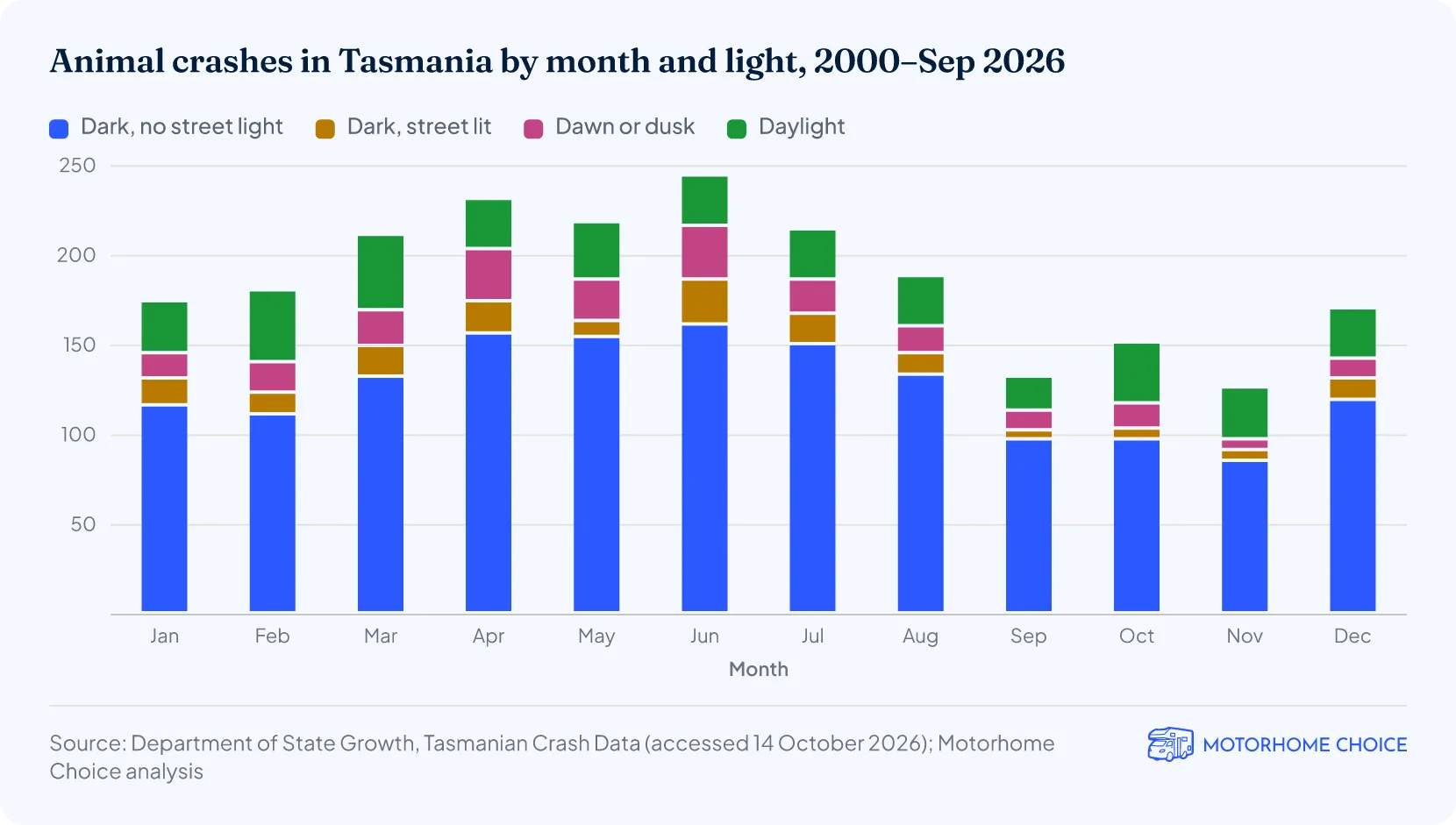
- 74% of those crashes happened in darkness and another 9% at dawn or dusk (2000–2026)3.
- 65% happened in 100 or 110 km/h zones (2000–2026)3.
- 350–450 road-killed Tasmanian devils reported each year, over 7,000 since 20094.
- 500,000 a year: RACT’s 2023 figure, with no published method5.
How many animals are killed on Tasmanian roads each year?
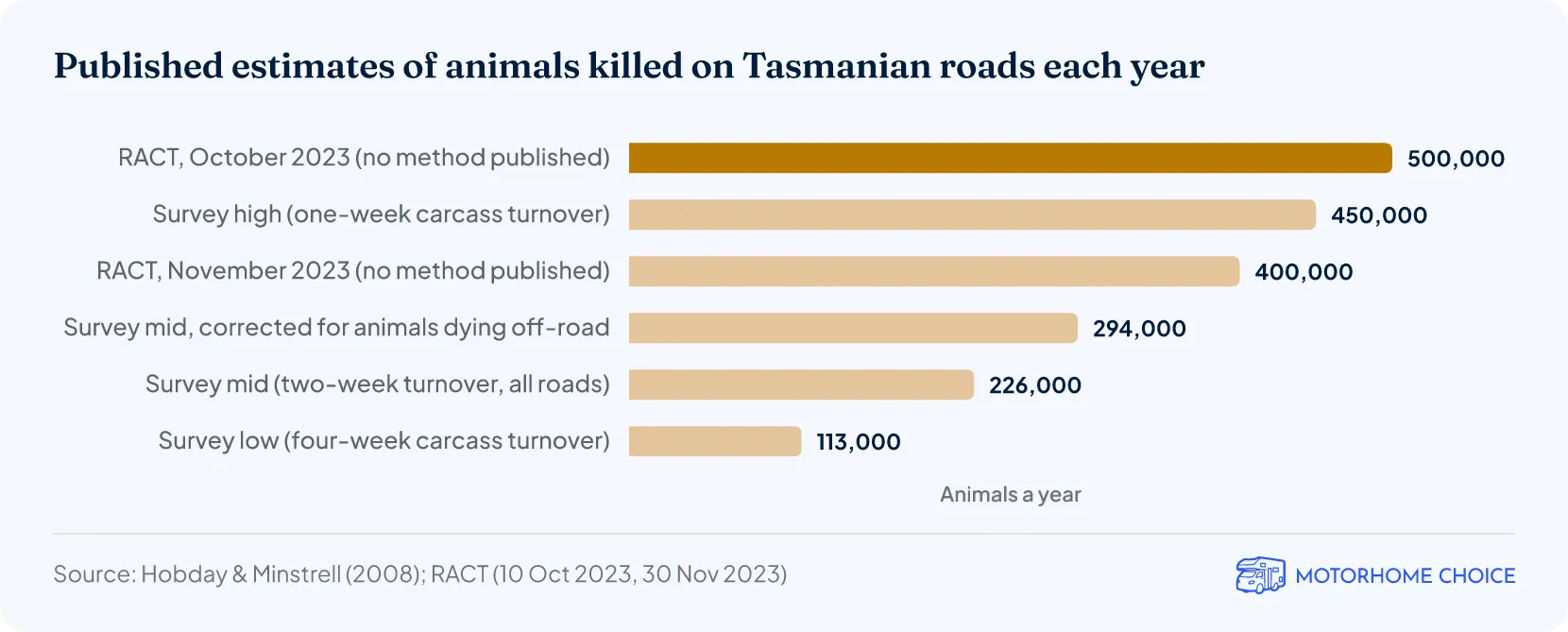
An estimated 294,000 animals are killed on Tasmanian roads each year, according to the only published survey-based estimate, built from road surveys between June 2001 and November 20041. The surveys are more than 20 years old and have not been repeated.
The researchers drove 154 surveys covering more than 15,000 km of state and federal roads and counted 5,691 dead animals from 54 taxa, about 0.37 carcasses per kilometre1. Assuming a carcass stays on the road for about two weeks and that all 23,380 km of Tasmanian roads look like the surveyed ones, they estimated 226,131 roadkill a year. Adding 30% for animals that are hit but die away from the road gives the mid-estimate of 294,000.
The estimate depends heavily on how long a carcass stays on the road: a four-week turnover gives 113,000 a year and a one-week turnover 450,0001. The paper also states a wider range of 377,000 to 1.5 million for animals larger than bandicoots and small birds.
Where does the 500,000 figure come from?
The 500,000 figure comes from RACT, Tasmania’s motoring club, which said in October 2023 that “over 500,000 animals are tragically killed on Tasmanian roads each year”5. RACT does not say how it was calculated, and a member article it published seven weeks later says “over 400,000”6.
The same release quotes a wildlife rescuer who says up to half a million native animals die and that this equates to about 32 an hour5. But 32 an hour is about 280,000 a year, close to the survey estimate rather than 500,000 (our calculation).
Is Tasmania the roadkill capital of the world?
No one has shown that it is: “roadkill capital of the world” is a reputation, not a measured ranking. Even the 2008 survey says only that roadkill in Tasmania is “perceived as relatively greater than in other Australian states”1.
The estimates are high for a state of 580,700 residents (31 March 2026)7: between half an animal and almost one animal per resident each year.
| Estimated roadkill per Tasmanian resident | |||
|---|---|---|---|
| Estimate | Animals a year | Per resident | In plain words |
| Survey mid-estimate, corrected (2001–04 data) | 294,000 | 0.51 | about 1 for every 2.0 residents |
| RACT, November 2023 | 400,000 | 0.69 | about 1 for every 1.5 residents |
| RACT, October 2023 | 500,000 | 0.86 | about 1 for every 1.2 residents |
Source · Hobday & Minstrell (2008); RACT (2023); Australian Bureau of Statistics, March 2026; Motorhome Choice calculation.
How many animals are reported in the Roadkill Reporter app?
Almost 2,000 animals were reported through the Tasmanian Roadkill Reporter app in the year to December 2025, the Minister for the Environment said on 22 December 20252. The app counts only the carcasses people stop to log: well under 1% of the 294,000 survey estimate.
The most common species reported through the app were pademelons, wallabies, brush-tailed possums, Tasmanian devils and common wombats2.
The app replaced the Roadkill TAS app, which closed on 31 August 2021 after a three-year trial9. Its reports go to the Natural Values Atlas and the LIST to help road owners find hotspots.
Which animals are killed most on Tasmanian roads?
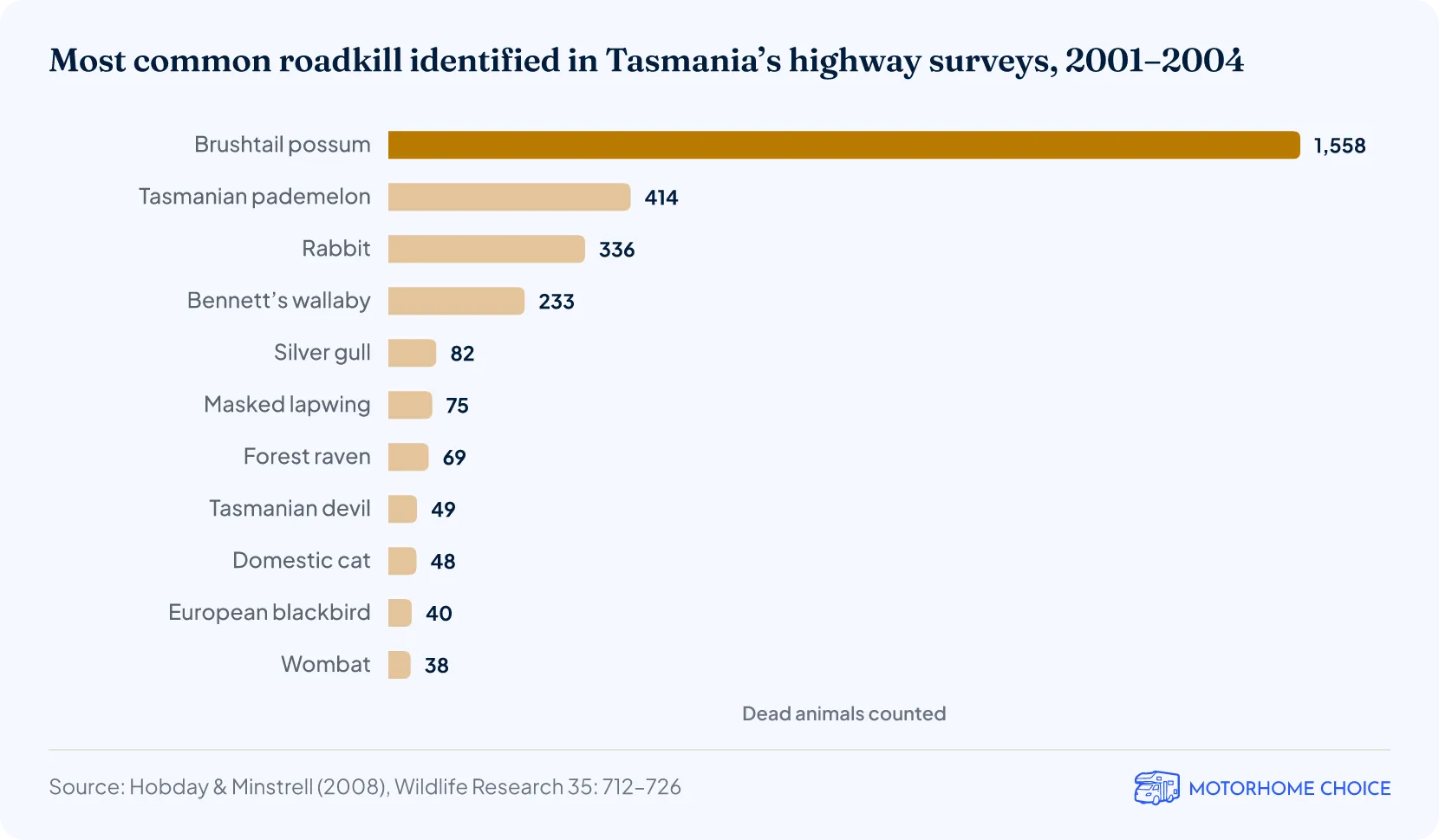
Brushtail possums were the most common roadkill in Tasmania’s largest road survey: 1,558 of the 5,691 dead animals counted in 2001–2004, or 48% of those identified to species1. Tasmanian pademelons (414), rabbits (336) and Bennett’s wallabies (233) came next.
Wombats were 13th of all categories, with 38 counted1. Silver gulls, masked lapwings and forest ravens were the birds most often identified, and the surveys also counted 49 Tasmanian devils and 48 domestic cats.
How many Tasmanian devils are killed on roads?
Between 350 and 450 road-killed Tasmanian devils are reported to the Save the Tasmanian Devil Program each year, and more than 7,000 have been reported since its roadkill project began in 20094. Reports are sightings, so the true number is likely higher.
In Parliament on 7 September 2022, Greens MP Rosalie Woodruff said government figures confirmed 220 devils had been killed on Tasmania’s roads in the previous 18 months, and that at least 158 had died on the 25 km stretch of Woolnorth Road in the state’s north-west10. Hansard does not say what the 220 covers. The minister, Roger Jaensch, did not dispute the numbers, saying the region “has one of the highest reported rates of devil road kill” because it supports some of the highest-known devil densities in the state.
The 2001–2004 survey estimated about 3,392 devils a year were killed on roads, which it put at 3.8–5.7% of the devil population at that time1. Devils are hardest to see on a black, wet road. To see one and stop in time, a driver should be doing no more than 54 km/h4. The worst months are late spring to the end of summer, when young devils leave home, and April to August, when a female killed on the road may be carrying young.
How many crashes with animals do police record in Tasmania?
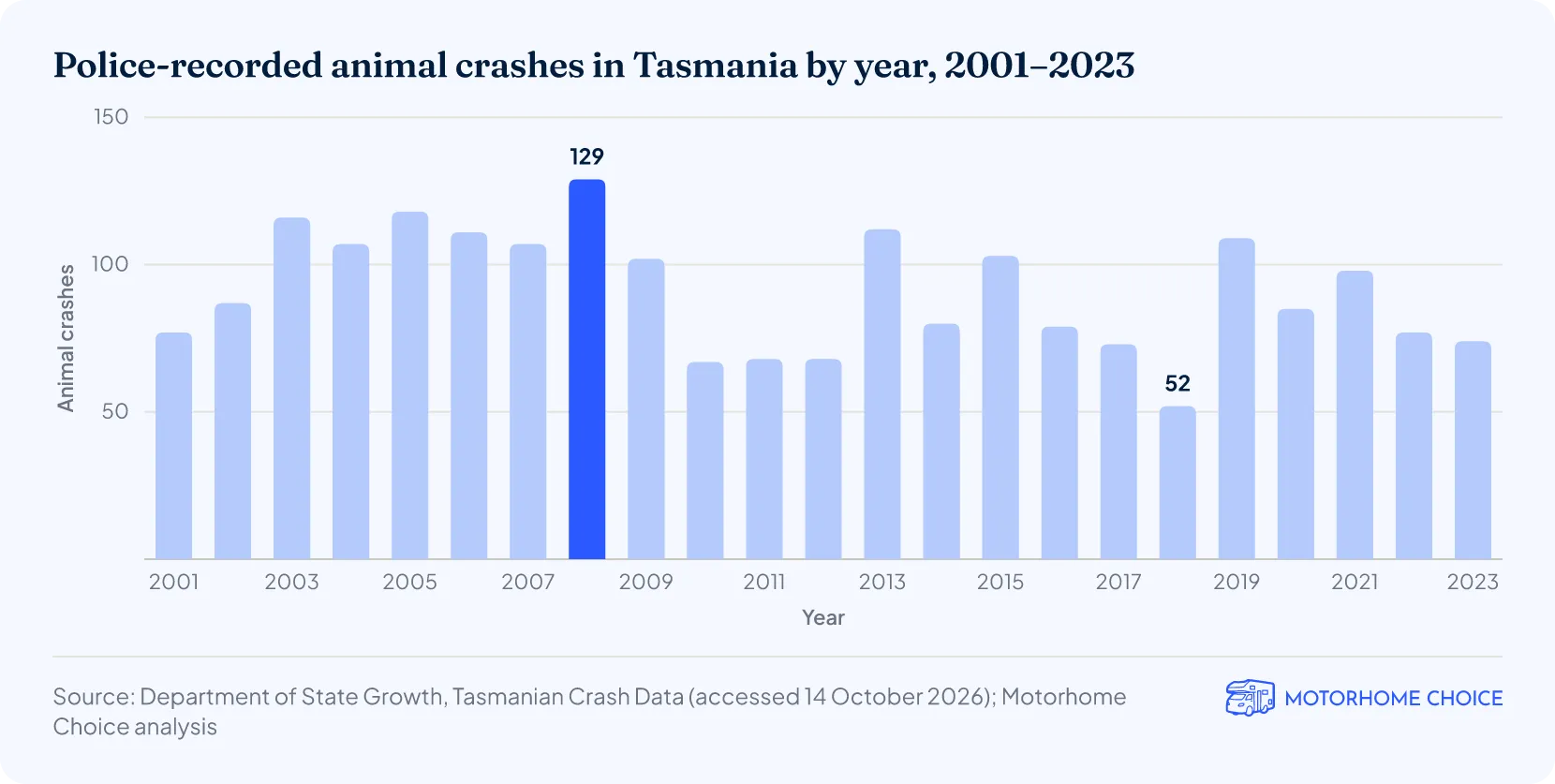
Police recorded 2,256 crashes caused by an animal on Tasmanian roads between March 2000 and 12 September 2026, according to the Department of State Growth’s crash data3. From 2014 to 2023 they averaged 83 a year.
Police-recorded crashes are a small slice of all collisions: about 3,000 wildlife-related vehicle insurance claims were expected across Tasmania in 20235, costing Tasmanians around $9.5 million a year6.
Most police-recorded animal crashes damage only the vehicle: 83% caused no recorded injury3. Three were fatal and 56 caused serious injuries.
| Police-recorded animal crashes in Tasmania by severity, 2001 to September 2026 | ||
|---|---|---|
| Severity | Crashes | Share |
| Fatal | 3 | 0.1% |
| Serious injury | 56 | 2.5% |
| Minor injury | 224 | 9.9% |
| First aid | 71 | 3.1% |
| Property damage only | 1,876 | 83.2% |
| Not known | 26 | 1.2% |
Source · Department of State Growth, Tasmanian Crash Data (accessed 14 October 2026); Motorhome Choice analysis.
When do animal crashes happen in Tasmania?
Three in four police-recorded animal crashes (74%) happened in darkness, and another 9% at dawn or dusk; only 16% were in daylight3. June has the most (244 since 2000) and November the fewest (127), so crashes peak in the months with the longest nights (our calculation).
Wildlife encounters peak between 4 am and 6 am and between 5 pm and 11 pm6.
| Heatmap: animal crashes by month and light condition, 2001 to September 2026 | ||||||
|---|---|---|---|---|---|---|
| Month | Dark, no street light | Dark, street lit | Dawn or dusk | Daylight | All crashes | Share in darkness or at dawn/dusk |
| Jan | 116 | 15 | 14 | 29 | 176 | 82% |
| Feb | 111 | 12 | 17 | 40 | 181 | 77% |
| Mar | 132 | 17 | 20 | 42 | 217 | 78% |
| Apr | 156 | 18 | 29 | 28 | 233 | 87% |
| May | 154 | 9 | 23 | 32 | 218 | 85% |
| Jun | 161 | 25 | 30 | 28 | 244 | 89% |
| Jul | 150 | 17 | 19 | 28 | 215 | 87% |
| Aug | 133 | 12 | 15 | 28 | 188 | 85% |
| Sep | 97 | 5 | 11 | 19 | 134 | 84% |
| Oct | 97 | 6 | 14 | 34 | 152 | 77% |
| Nov | 85 | 6 | 6 | 29 | 127 | 76% |
| Dec | 119 | 12 | 11 | 28 | 171 | 83% |
Source · Department of State Growth, Tasmanian Crash Data (accessed 14 October 2026); Motorhome Choice analysis.
Which roads have the most animal crashes?
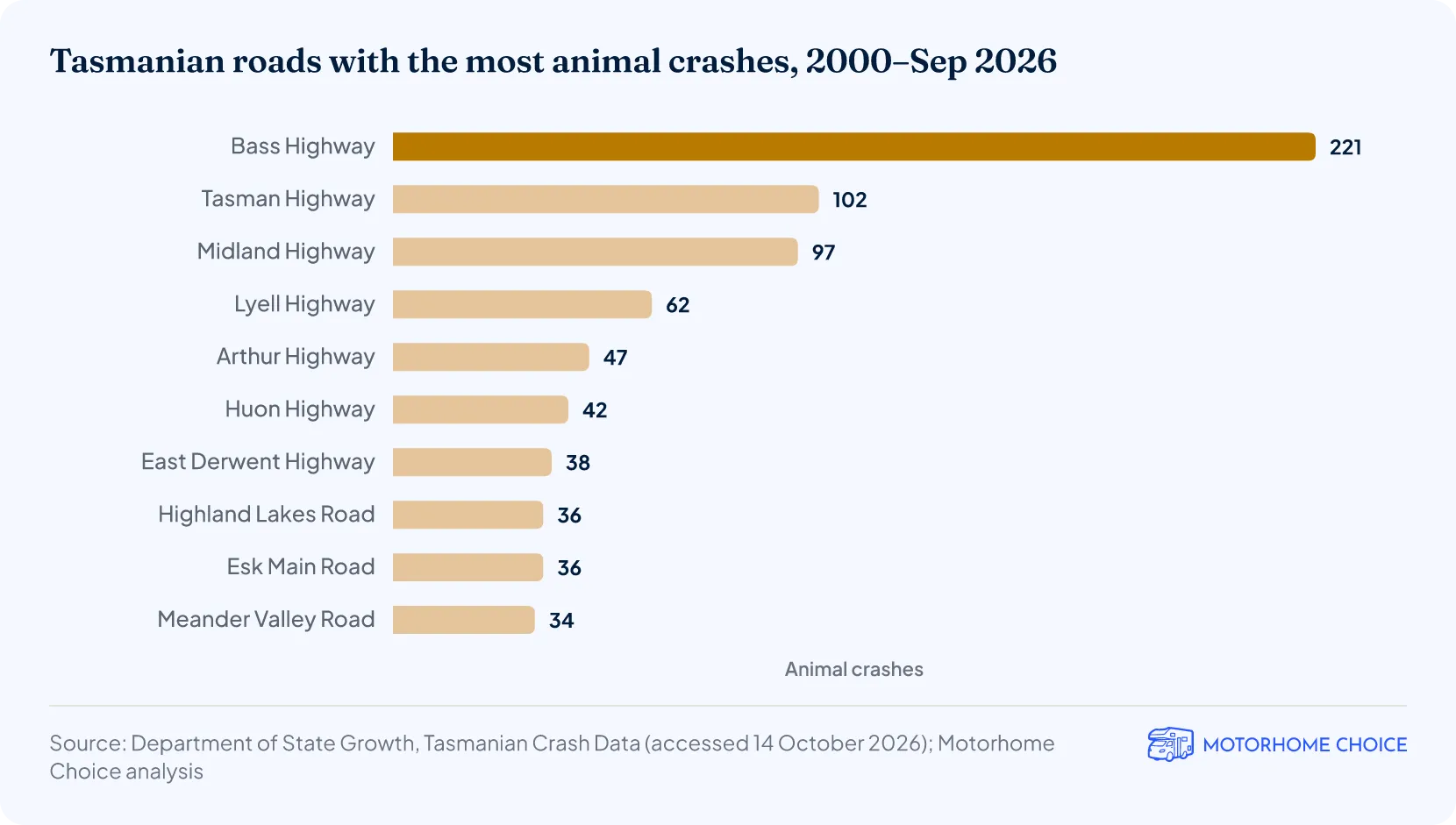
The Bass Highway has the most police-recorded animal crashes of any Tasmanian road: 221 since 2000, about one in ten3. The Tasman Highway (102) and Midland Highway (97) follow.
By council area, Meander Valley (181), Northern Midlands (148) and Launceston (136) record the most animal crashes3.
| Council areas with the most police-recorded animal crashes, 2001 to September 2026 | ||
|---|---|---|
| Council area | Crashes | Share of all animal crashes |
| Meander Valley | 181 | 8.0% |
| Northern Midlands | 148 | 6.6% |
| Launceston | 136 | 6.0% |
| Circular Head | 130 | 5.8% |
| Clarence | 126 | 5.6% |
| West Tamar | 101 | 4.5% |
| Waratah-Wynyard | 100 | 4.4% |
| Dorset | 95 | 4.2% |
| Central Highlands | 89 | 3.9% |
| Latrobe | 87 | 3.9% |
Source · Department of State Growth, Tasmanian Crash Data (accessed 14 October 2026); Motorhome Choice analysis.
How many animal crashes happen in 100 km/h zones?
| Police-recorded animal crashes in Tasmania by speed zone, 2001 to September 2026 | ||
|---|---|---|
| Speed zone | Crashes | Share |
| 110 km/h | 200 | 8.9% |
| 100 km/h | 1,259 | 55.8% |
| 90 km/h | 31 | 1.4% |
| 80 km/h | 337 | 14.9% |
| 70 km/h | 61 | 2.7% |
| 60 km/h | 201 | 8.9% |
| 50 km/h | 105 | 4.7% |
| 40 km/h or less | 8 | 0.4% |
| Not known or not stated | 54 | 2.4% |
Source · Department of State Growth, Tasmanian Crash Data (accessed 14 October 2026); Motorhome Choice analysis.
How can drivers avoid hitting wildlife in Tasmania?
The Tasmanian Government’s advice is to slow down, especially between dusk and dawn, or avoid driving then2. If you’re hiring a motorhome or campervan in Tasmania, plan each day’s drive so you reach your campsite before dusk.
Road managers use signs, roadside slashing, light-coloured bitumen, rumble strips and virtual fencing, often together8. If you see roadkill, you can log it in the Tasmanian Roadkill Reporter app, but only when it is safe: it is illegal to touch your phone while driving or waiting at traffic lights2.
More Tasmania facts & statistics
Motorhome and campervan hire in Tasmania
References
- Hobday & Minstrell (2008), Distribution and abundance of roadkill on Tasmanian highways: human management options, Wildlife Research 35(7): 712–726publish.csiro.auPublished 2008-01-01 · Retrieved 2026-10-14
- Safer speeds save wildlife these holidays (Minister for the Environment media release, 22 December 2025)premier.tas.gov.auPublished 2025-12-22 · Retrieved 2026-10-14
- Tasmanian Crash Data (CDM_CRASH feature service), Department of State Growth, Tasmaniadata.stategrowth.tas.gov.auRetrieved 2026-10-14
- Tasmanian Devil Roadkill Project – Save the Tasmanian Devil Program (NRE Tasmania)nre.tas.gov.auRetrieved 2026-10-14
- RACT, Campaign calls on drivers to reduce speed to protect wildlife (10 October 2023)ract.com.auPublished 2023-10-10 · Retrieved 2026-10-14
- RACT, Drive to protect Tasmania’s native wildlife (30 November 2023)ract.com.auPublished 2023-11-30 · Retrieved 2026-10-14
- ABS, National, state and territory population, March 2026Australian Bureau of StatisticsPublished 2026-09-17 · Retrieved 2026-10-12
- House of Assembly Hansard, 7 September 2022, Questions without notice: Tasmanian devils – road kill numbers (Parliament of Tasmania)search.parliament.tas.gov.auPublished 2022-09-07 · Retrieved 2026-10-14