

Published
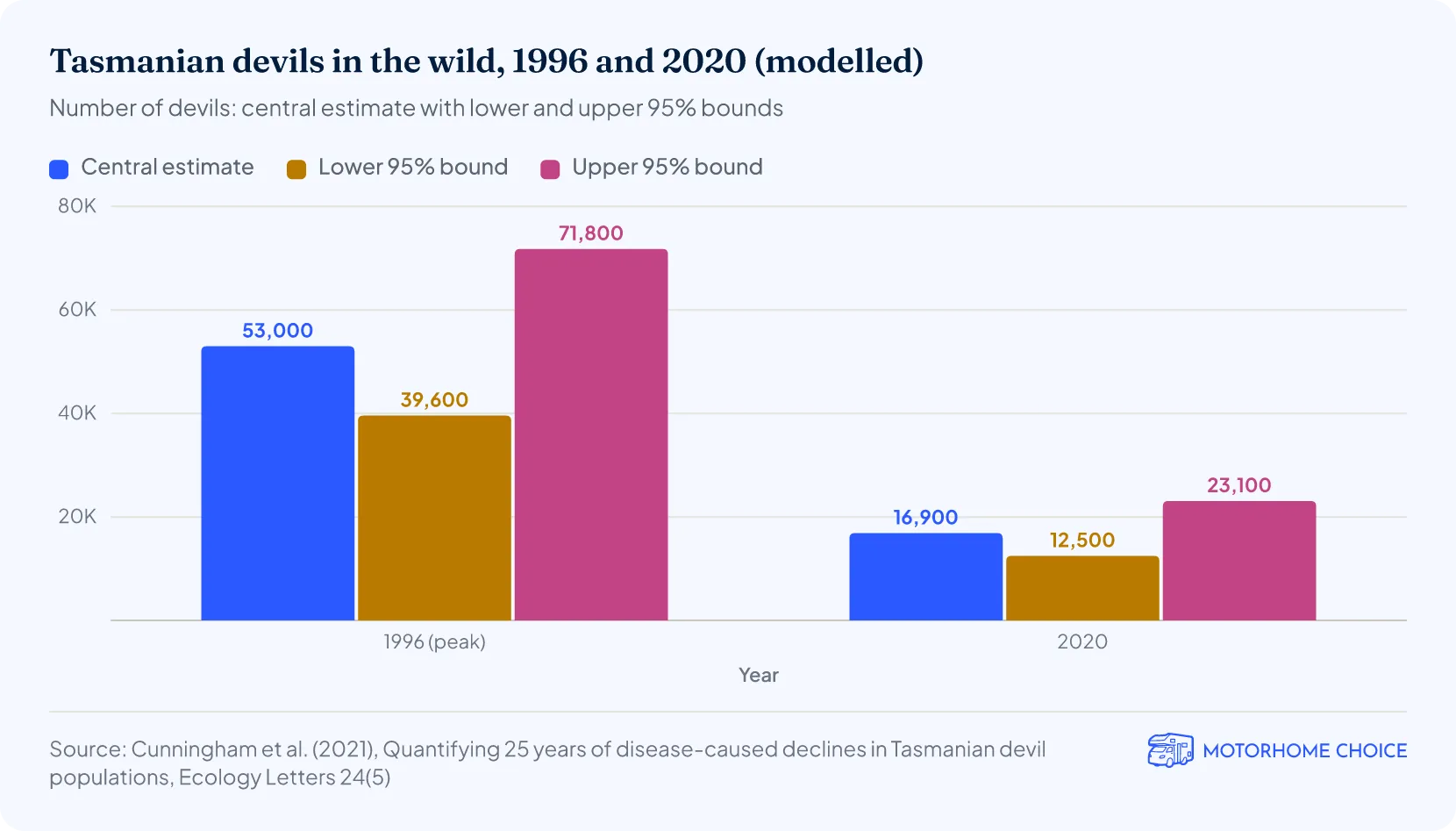
About 17,000 Tasmanian devils were living in the wild in 20201, according to the latest peer-reviewed population estimate. That is about two-thirds fewer than the peak of around 53,000 in 1996, the year devil facial tumour disease was first recorded. By 2020 the disease had reached more than 90% of the devils' range. The real 2020 number could be anywhere from about 12,500 to 23,100.
Key facts
- About 17,000 devils were estimated to be living in the wild in 2020 (range about 12,500 to 23,100).1
- 53,000 devils was the modelled peak, reached in 1996, the year facial tumour disease was first recorded.1
- More than 90% of the devil's range had facial tumour disease by 2020.1
- 82% is the average drop in devil numbers in an area 23 years after the disease arrives there.1
- 2 separate contagious cancers infect devils: DFT1, first recorded in 1996, and DFT2, first recorded in 2014.2
- More than 7,000 road-killed devils have been reported to the Save the Tasmanian Devil Program since 2009, between 350 and 450 a year.3
- 6 years is the longest a Tasmanian devil lives in the wild.4
- 1941 is the year devils were protected by law4; they were listed as endangered in Tasmania in 2008 and nationally in 2009.5
How many Tasmanian devils are left in the wild?
About 16,900 Tasmanian devils were left in the wild in 2020, the most recent year covered by a peer-reviewed statewide estimate.1 The figure comes from a model led by University of Tasmania researchers that combined 35 years of spotlight surveys with devil density estimates from trapping. Its 95% credible interval runs from 12,500 to 23,100 devils.
- The population peaked at about 53,000 in 1996 (95% interval 39,600 to 71,800), less than half the earlier estimate of 130,000 to 150,000 devils.1 The older estimate scaled up counts from study sites in prime devil habitat to the whole state, including poorer country such as the south-west.
- The 2020 total is 68% below that peak.1 On average the wild population shrank by about 1,500 devils a year between 1996 and 2020.
- Average density fell from 0.84 devils per km² in 1996 to 0.27 per km² in 20201, about one devil for every 3.7 km².
- The model forecast that the decline should level off within the decade after 2020.1
What is devil facial tumour disease?
Devil facial tumour disease (DFTD) is a fatal cancer that passes from devil to devil through biting during fighting and mating. It is one of only a few known cancers that spread like a contagious disease.2 Two separate cancers infect devils: DFT1, first recorded in 1996, and DFT2, first recorded in 2014.
- Infected devils usually die within a few months of the tumours becoming visible, often of starvation once tumours make eating difficult.2
- In diseased areas nearly all devils older than two years become infected, so females now typically breed once instead of the usual three times.2
- DFT1 has spread throughout Tasmania; DFT2 has so far been found only in the Channel area in the south-east.2
| DFT1 and DFT2 compared | ||
|---|---|---|
| Feature | DFT1 | DFT2 |
| First recorded | 19962 | 20142 |
| Origin | Female2 | Male2 |
| Where found | Throughout Tasmania2 | So far only the Channel area2 |
| Outcome | Contagious and fatal2 | Contagious and fatal2 |
Source · NRE Tasmania, Save the Tasmanian Devil Program, About Devil Facial Tumour Disease (checked October 2026).
How far has devil facial tumour disease spread?
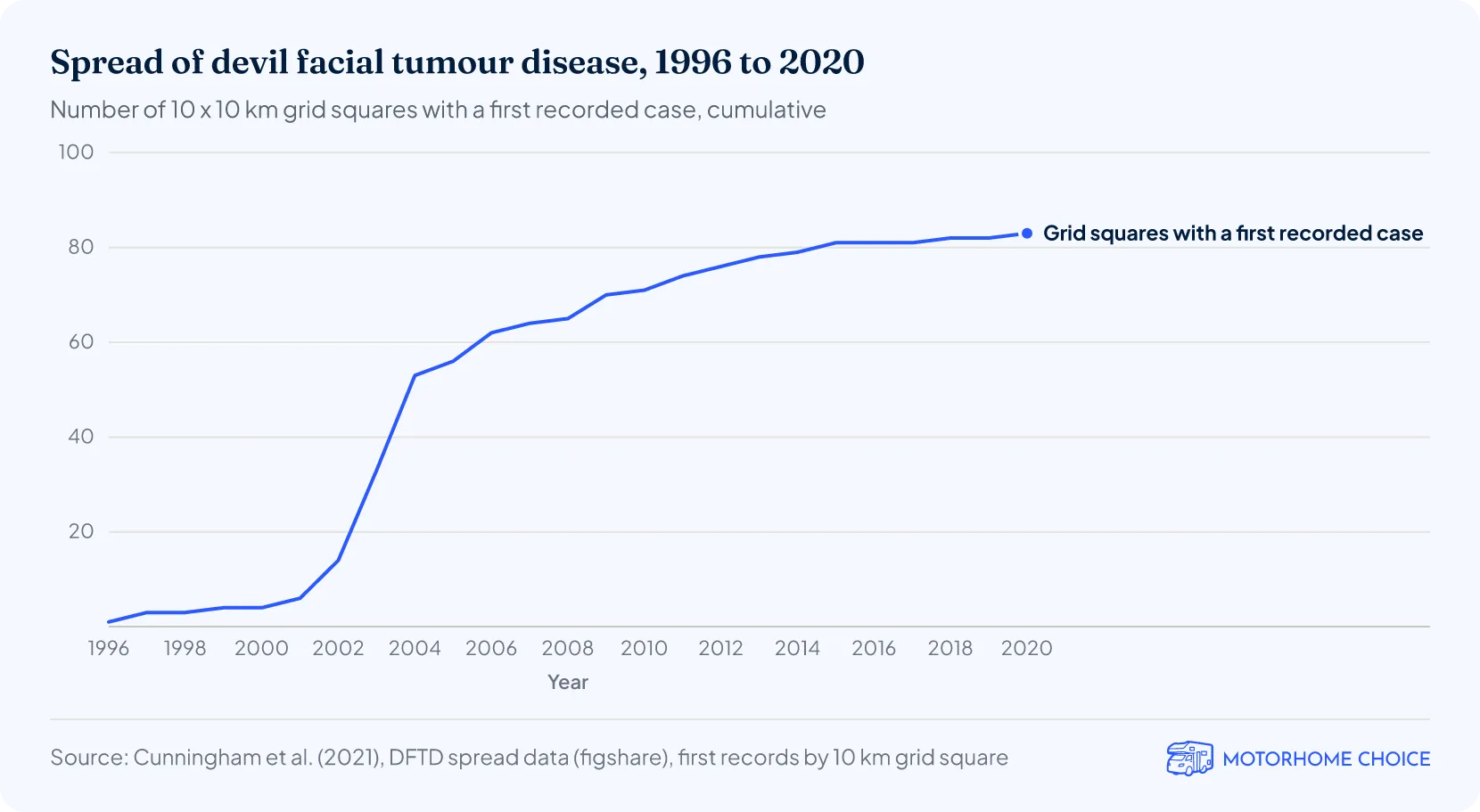
By 2020 devil facial tumour disease occupied more than 90% of the devil's range in Tasmania.1 It was first noticed in the north-east of the state in the mid-1990s6 and spread fastest through areas with many devils, slowing where devils were scarce.1
- The study's records of first cases cover 83 grid squares of 10 by 10 km17: 53 had their first recorded case by 2004 and 81 by 2015 (our count).
- Camera surveys along the south-west coast found no disease between 2016 and 2020, and one long-term trapping site in the far north-west was still disease-free. The model expected the disease to reach those sites around 2022.1
How much do devil numbers fall where the disease arrives?
How many Tasmanian devils are killed on the roads?
More than 7,000 road-killed Tasmanian devils have been reported to the Save the Tasmanian Devil Program since its Roadkill Project began in 2009, between 350 and 450 a year.3 That is roughly 2% to 3% of the estimated 2020 wild population each year (our calculation). The real toll is higher, because only devils that someone finds and reports are counted.
- Devils are one of the five species most often reported in the Tasmanian Roadkill Reporter app, with pademelons, wallabies, brush-tailed possums and common wombats.8 The app logged almost 2,000 animals of all species in the year to December 2025.
- To see a devil and stop in time, a driver should be doing no more than 54 km/h; most people drive at about twice that on country roads.3
- The worst time of year is late spring to the end of summer, when young devils leave home and holiday traffic increases. From about April to August, females are pregnant or carrying pouch young.3
- If you are touring Tasmania in a hired motorhome or campervan, plan each day's drive to finish before dark; if you are on the road later, slowing down between dusk and dawn is the most effective way to avoid hitting a devil.3
Are Tasmanian devils endangered?
Yes. The Tasmanian devil is listed as endangered under Tasmania's Threatened Species Protection Act 1995 (since May 2008) and the national Environment Protection and Biodiversity Conservation Act 1999 (since May 2009), and was up-listed to endangered on the IUCN Red List in late 2008.5
- Devils have been protected by law since June 1941, after more than a century of trapping and poisoning.4
- In 1830 the Van Diemen's Land Co. offered a bounty of 2/6 (two shillings and sixpence, or 25 cents in today's decimal currency) for a male devil and 3/6 (35 cents) for a female.4
- Devil facial tumour disease is a declared disease under Tasmania's Biosecurity Act 2019.5
| Tasmanian devil protection and conservation status | ||
|---|---|---|
| Listing | Status | Since |
| Tasmanian law | Wholly protected | June 19414 |
| Threatened Species Protection Act 1995 (Tasmania) | Endangered | May 20085 |
| IUCN Red List | Endangered | Late 20085 |
| EPBC Act 1999 (Australia) | Endangered | May 20095 |
Source · NRE Tasmania, Tasmanian Devil (Fauna of Tasmania) and About the Tasmanian Devil (checked October 2026).
How long do Tasmanian devils live?
Tasmanian devils live for up to six years in the wild.4 The devil is the world's largest surviving carnivorous marsupial: adult males can weigh up to 14 kg and stand about 30 cm high at the shoulder.
- Devils mate between February and May. After a 21-day gestation, up to 40 young are born, but the pouch has only four teats, so no more than four can survive.5
- Young spend about four months in the pouch and usually start breeding at the end of their second year.4
- Devils once lived on mainland Australia but died out there about 3,500 years ago, long before European settlement.4
| Tasmanian devil facts | |
|---|---|
| Fact | Figure |
| Lifespan in the wild | Up to 6 years4 |
| Weight of an adult male | Up to 14 kg4 |
| Height at the shoulder | About 30 cm4 |
| Gestation | 21 days4 |
| Young born per litter | Up to 405 |
| Young that can survive in the pouch | Up to 4 (2 or 3 on average)4 |
| Time in the pouch | About 4 months4 |
| Distance roamed in a night | Up to 16 km4 |
| Died out on the mainland | About 3,500 years ago4 |
Source · NRE Tasmania, About the Tasmanian Devil and Tasmanian Devil (Fauna of Tasmania), checked October 2026.
What is being done to save the Tasmanian devil?
The Save the Tasmanian Devil Program, a joint initiative of the Australian and Tasmanian governments, was set up in 2003 as the official response to the threat of extinction from facial tumour disease.9
- An insurance population of more than 600 healthy devils is kept around Australia, including a disease-free population on Maria Island.6
- Healthy devils from the insurance population are released into the wild to boost the numbers and genetic diversity of wild populations.6
- Wild devils are monitored with catch-and-release trapping and remote cameras, and researchers are working on a vaccine.6
- The 2021 population study supports management that helps devils evolve resistance and tolerance to the disease.1
More Tasmania facts & statistics
Motorhome and campervan hire in Tasmania
References
- Quantifying 25 years of disease-caused declines in Tasmanian devil populations: host density drives spatial pathogen spread (Cunningham et al. 2021, Ecology Letters)pmc.ncbi.nlm.nih.govPublished 2021-02-27 · Retrieved 2026-10-14
- About Devil Facial Tumour Disease – Save the Tasmanian Devil Program (NRE Tasmania)nre.tas.gov.auRetrieved 2026-10-14
- Tasmanian Devil Roadkill Project – Save the Tasmanian Devil Program (NRE Tasmania)nre.tas.gov.auRetrieved 2026-10-14
- About the Tasmanian Devil – Save the Tasmanian Devil Program (NRE Tasmania)nre.tas.gov.auRetrieved 2026-10-14
- Tasmanian Devils under Threat – Save the Tasmanian Devil Program (NRE Tasmania)nre.tas.gov.auRetrieved 2026-10-14
- DFTD spread data: first records of devil facial tumour disease by 10 km grid cell (Cunningham et al. 2021, figshare)doi.orgPublished 2021-01-27 · Retrieved 2026-10-14
- Safer speeds save wildlife these holidays (Minister for the Environment media release, 22 December 2025)premier.tas.gov.auPublished 2025-12-22 · Retrieved 2026-10-14
- Save the Tasmanian Devil Program (NRE Tasmania)nre.tas.gov.auPublished 2026-06-16 · Retrieved 2026-10-14